
I have known for a while now that I may not get classes to teach next fall at my current institution. Universities are continuously being defunded while increasingly embracing generative AI solutions instead of investing in students, staff, and teachers. As a young gig lecturer whose own research studies labor precarity, I know it is not looking good and I would be one of the firsts on the chopping board.
I remember telling my therapist: “It would have been a shame if I don’t get to teach anymore.” I have continued feeling that way everyday since. As I taught what might be my last semester, attended my first (and potentially last) graduation ceremony as a faculty member, and cheered on students near and far, I found myself grieving an uncertain future while also trying to understand what exactly I was grieving.
The answer, I realized, is not simply teaching as a job. It is teaching as a way of being in relationship with other people. Over the years, I have come to believe that education is about much more than the content we teach. It is about connection, care, curiosity, joy, the discomfort of failure and trying again, the practice of listening with respect and empathy, and the willingness to encounter different people and perspectives. Losing the opportunity to teach would feel like a loss because it would mean losing one of the most meaningful ways I have learned to practice those values.
This is not a eulogy for my teaching career. But this moment of uncertainty has compelled me to look back and reflect on how teaching became so important to me.
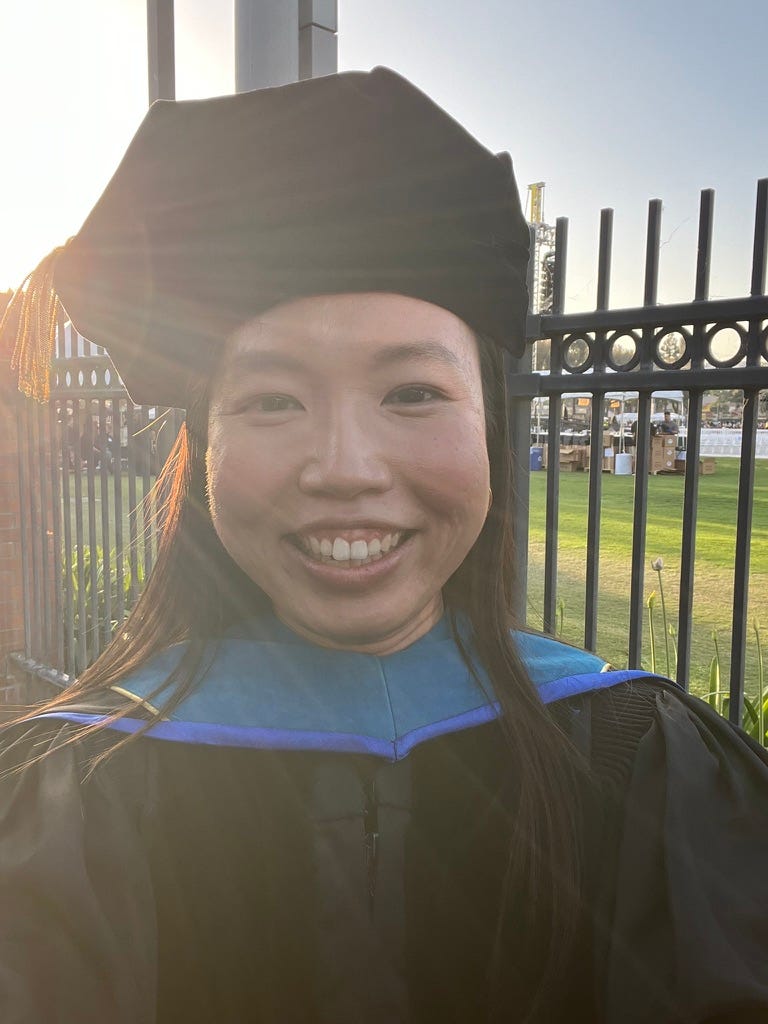
A selfie of myself before the sunset graduation.
My teaching career began unexpectedly in 2017. Before I had even started my formal TA training, I was suddenly responsible for two sections of undergraduate students. I was not a particularly good teacher at first, but those early years taught me what kind of educator I did not want to become. More importantly, they revealed how much I enjoyed the challenge of helping students make sense of ideas together.
The turning point came in Spring 2022 when, as a doctoral candidate, I designed and taught my own seminar, Influencer Culture and Economy. The course was ambitious, discussion-heavy, and filled with students from vastly different disciplines. I was anxious throughout the quarter, but I also experienced a kind of classroom synergy that was difficult to describe. Beyond engaging with extremely topical theories and case studies, we genuinely saw and heard one another in the classroom. Students from engineering, health sciences, english, and political science found surprising points of connection through our discussions of platform culture and digital labor. Looking back, that was probably when I fell in love with teaching and began to understand what kind of educator I wanted to be.
After earning my PhD, I returned to teaching while navigating the academic job market, healing from burnout, and working through years of accumulated trauma in therapy. As I gradually pulled back from constant hustling and invested more intentionally in my own wellbeing, I found myself becoming a better teacher. I had more capacity to connect with students, listen carefully, and create the kind of classroom environment I value most. Ironically, it was only after slowing down that I fully understood how much teaching mattered to me.
I know I now have more capacity to get to know my students despite the challenges posed by larger class sizes and conventional expectations around professional boundaries. Through a combination of assignments, pedagogical tools, and simple care and curiosity, I try to understand who my students are beyond the names on my roster. One of the things I am proudest of as a teacher is that many students leave my classes feeling seen, heard, and valued.
Of course, content matters. I take great pride in my course design and teaching materials. But what excites me most about teaching is creating the conditions for students to engage deeply with ideas, with one another, and with themselves. The most meaningful moments in the classroom are often not when I am delivering information, but when students take intellectual risks, discover new perspectives, or feel confident enough to share a thought they might otherwise have kept to themselves.
This commitment to connection and engagement is one reason I deeply resonate with bell hooks’ assertion in Teaching to Transgress that “the classroom should be an exciting place.” I am a champion of pleasure in the classroom, though by pleasure I do not mean instant gratification, easy agreement, or watering things down. I mean the pleasure of encountering a text that opens something up, of engaging with a film differently than before, of finding language for an experience, of thinking alongside others.
For me, cultivating pleasure in the classroom means choosing the right texts and examples, honing engaging delivery methods, bringing energy into lectures and discussions, and creating space for students’ voices to actually matter. One of the funniest compliments I have received from a student was that he eventually chose my Thursday evening class over parties because he realized the class was fun, exciting, and stimulating.
My experience confirms hooks’ point that excitement can “co-exist with and even stimulate serious intellectual and/or academic engagement.” I feel proud that many of my students got a taste of the joy of learning individually and collectively: watching film and media with care, analyzing culture across multiple levels, and hearing one another’s voices while recognizing one another’s presence. With this, I know I am on the path to becoming a great educator, if given the chance, the stability, and the support.
Most of the students I taught during my very first semester at this institution were graduating this past May. As such, I decided to make the effort to show up to as many end-of-year presentations, showcases, and celebrations as possible to cheer on these amazing students and to give myself a ritual of closure. I took so many pictures, videos, and cheered so loudly. I still do not know whether I will be teaching next fall. But after spending this semester working through my many emotions and celebrating my students’ achievements, I feel grateful for the chance to have shared a classroom with them at all. The uncertainty remains. So does the grief. But now I understand it better. It would have been a shame if I don’t get to teach anymore because teaching has become one of the ways I practice connection, care, curiosity, and joy.
Oh don't mind me over here in the corner emotional haha. Sensational! Working on the courage to write this openly and really resonate. Thank you!!!!
Thank you for sharing this - I hate how pervasive problems with teaching are, from if we’ll be able to teach successfully to if we will even get to teach at all.
Also, here is a post I wrote about academics on social media that you might find interesting - please check it out if you’d like! https://m0r94n.substack.com/p/should-academics-be-on-social-media?r=1fkxj7&utm_medium=ios